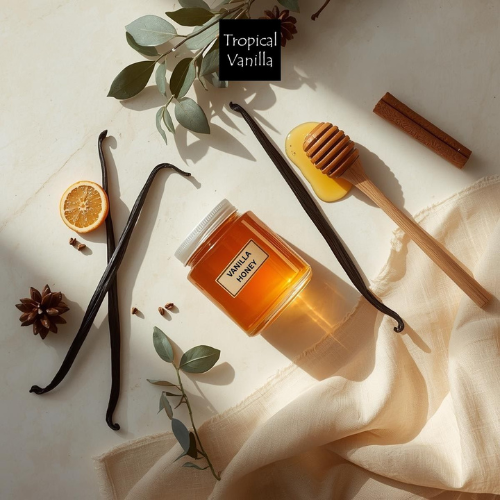
That pretty jar of vanilla honey sitting on your kitchen shelf has a secret. The vanilla flavour inside it almost certainly did not come from a vanilla flower. It came from a chemistry lab. And understanding why that matters will change how you read every honey label for the rest of your life.
Vanilla is the world’s most popular flavour. It appears in ice cream, baked goods, perfumes, candles, and yes, in hundreds of honey products lining supermarket shelves. There is just one problem. Real vanilla is extraordinarily expensive, painstakingly labour-intensive to produce, and globally scarce. So when you see “vanilla honey” in the grocery store at a normal price, a simple question is worth asking: where exactly did that vanilla flavour come from?
The answer is simultaneously fascinating and a little unsettling. It starts with a compound called vanillin, a factory in Europe or China, and sometimes a byproduct of the wood pulp industry. It ends with a squeeze of flavouring compound added to heavily processed bulk honey that had its own natural character boiled away weeks earlier.
Real vanilla comes from the seed pods of the Vanilla planifolia orchid, a climbing vine native to Mexico and now cultivated in Madagascar, Tahiti, and Indonesia. The vanilla orchid must be hand-pollinated because its natural pollinator does not exist outside of Mexico. Each flower blooms for just one single day. After successful pollination, the pod takes nine months to mature before it can be harvested. The pods are then cured for three to six months in a process involving blanching, sweating, drying, and conditioning that is entirely done by hand.
The result of all this effort is one of the most labour-intensive spice crops on earth, rivalling saffron in the care required per kilogram produced. Real vanilla extract contains over 200 distinct flavour compounds that work together to create that warm, complex, unmistakably vanilla character. It is expensive for excellent reasons.
If a jar of vanilla honey costs what a regular jar of honey costs, or only slightly more, the vanilla flavour in it was not sourced from real vanilla beans or real vanilla extract. Real vanilla is one of the most expensive food ingredients in the world. A product made with genuine vanilla extract would be priced to reflect that. If it is not, something else is providing the vanilla taste.
The key compound responsible for the taste and aroma of vanilla is called vanillin. It is a phenolic aldehyde molecule with the chemical formula C8H8O3. Vanillin is naturally present in vanilla beans and is also found in much smaller quantities in a handful of other natural sources including clove oil, some oak bark, and certain grains.
Here is where it gets interesting. Vanillin can also be synthesised entirely in a laboratory, and the synthetic version is chemically identical to the vanillin found in real vanilla beans. This means it tastes the same at the molecular level, but it was never near a vanilla orchid. It came from somewhere considerably less romantic.
Most of the world’s synthetic vanillin is manufactured from guaiacol, a chemical compound that can be derived from petrochemicals. In the early twentieth century, it was also produced from lignin, a byproduct of the wood pulp industry used to make paper. Historically, some 60 percent of global synthetic vanillin came from a single paper mill in Canada during the 1980s.
Today, guaiacol-based synthesis is the dominant commercial route. The process converts guaiacol through a chemical reaction with glyoxylic acid to produce vanillin at a fraction of the cost of extracting it from real vanilla beans. Synthetic vanillin sells for roughly ten dollars per kilogram. Real vanilla extract costs hundreds of times more.
The final synthetic vanillin molecule is chemically identical to the vanillin in a vanilla bean. Humans cannot taste the difference in a blind test between synthetic and real vanillin when tested in isolation. The real difference is what is missing: real vanilla extract contains over 200 flavour compounds beyond vanillin that create its full, complex character. Synthetic vanillin contains just one molecule. One note instead of two hundred.
When a honey label says “vanilla flavour” or “natural flavours,” it could mean any of three very different things. Most consumers do not know these distinctions exist, and food manufacturers are not required to specify which type they are using.
| Type | Source | What It Contains | Cost |
|---|---|---|---|
| Real Vanilla Extract | Vanilla planifolia orchid pods, cured and extracted | 200+ flavour compounds including vanillin | Very high |
| Natural Vanillin | Derived from rice bran, clove oil, ferulic acid, or other plant sources through fermentation | Chemically identical to vanillin in vanilla beans but just one compound | High |
| Synthetic Vanillin | Guaiacol (often petrochemical derived) or historically lignin from wood pulp | One compound only: vanillin molecule, chemically identical to natural | Very low |
On a food label, all three of these can legally appear as “vanilla flavour” or “natural flavours” depending on the jurisdiction and the specific source used. You have almost no way of knowing which one you are getting unless the brand specifies “pure vanilla extract” on the label, which requires the use of real vanilla beans. If it just says “vanilla flavour” or “natural flavours,” the cheapest option available to the manufacturer was almost certainly used.
Now that you understand what the vanilla flavouring likely is, here is what actually happens when a brand makes vanilla honey in a commercial production context. This process applies to the vast majority of flavoured honey products sold in supermarkets at regular price points.
Large volumes of honey are purchased from commodity markets, often blended from multiple countries including China, Argentina, Ukraine, and others. The honey at this stage may already have limited traceability and limited quality control.
The bulk honey is heated to between 70 and 80 degrees Celsius to kill yeast, dissolve crystals, and extend shelf life. This process destroys virtually all live enzymes, reduces antioxidant content significantly, and eliminates the volatile aromatic compounds that give raw honey its natural flavour character.
The heated honey is pushed through extremely fine filters to remove all pollen, propolis traces, wax particles, and natural particulates. The result is a perfectly clear, visually appealing liquid with no identifiable floral origin and minimal remaining natural complexity.
A measured quantity of vanillin solution, most likely synthetic or natural vanillin rather than real vanilla extract, is blended into the processed honey. The amount is calibrated to produce a consistent vanilla taste in every batch regardless of the season, region, or original floral source of the honey.
The finished product is bottled and labelled. The ingredient list reads: honey, natural flavours. Or possibly: honey, vanilla flavour. Neither of these phrases tells you that the vanilla came from a laboratory compound rather than a flower, or that the honey base was pasteurised and stripped before the flavouring was added.
Vanilla honey is not honey that bees made from vanilla flowers. Bees cannot visit vanilla orchids at all in most parts of the world. The vanilla in your honey jar was made in a chemistry facility and added to processed honey that had its own character removed weeks before it reached you.
Tru-CocoB Honey NotesThis is the question that cuts to the heart of the whole premise. Could a honey brand be telling the truth when they call it vanilla honey, implying bees visited vanilla flowers to make it?
Technically, vanilla orchid flowers do produce nectar and bees can access them. However, vanilla orchid flowers are structured in a way that makes them almost impossible to self-pollinate and very difficult for most bee species to pollinate effectively. Outside of Mexico, where the native Melipona bee evolved alongside the vanilla orchid, vanilla flowers must be hand-pollinated by human workers for any fruit to set. In vanilla-growing regions, beekeeping operations are not typically set up near vanilla plantations because the bee-flower relationship does not produce meaningful honey yields.
This means that if a brand were somehow producing honey from bees that had genuinely foraged on vanilla orchid flowers in sufficient quantity to flavour the honey, it would be extraordinarily rare, extraordinarily expensive, and would be prominently marketed as such. It would not sit on a supermarket shelf next to the clover honey at a comparable price. If you see vanilla honey at a normal price, the vanilla was added after the fact. Always.
Here is the part that makes the whole flavoured honey industry feel particularly unnecessary. Real single-origin raw honey already produces naturally occurring flavour profiles that are just as complex, just as distinct, and just as delicious as anything a food chemist could add. Bees do not need help making interesting honey. They have been doing it for 34 million years.
Notice that sweet clover honey naturally produces vanilla-adjacent flavour notes without a single drop of vanillin being added. This happens because the aromatic compounds in sweet clover nectar contain molecules that share structural similarities with the vanillin compound. Nature found the same flavour before the chemist did. The difference is that in real honey, these notes are part of a complex web of 200-plus compounds that create depth and nuance. In artificially flavoured honey, there is only the single added molecule, clean and one-dimensional.
This is the only phrase that guarantees real vanilla beans were involved. It is almost never seen on honey labels because real vanilla extract is extremely expensive and would dramatically increase the product price.
This means the honey’s flavour is entirely from its floral source. Whatever taste you experience was created by bees visiting specific flowers, not by a flavouring compound added in a factory.
In most jurisdictions, this can mean synthetic vanillin derived from guaiacol or a lab-fermented vanillin from plant sources. It does not mean real vanilla extract. It means the cheapest legally natural-labelled vanillin compound available to the manufacturer was used.
This explicitly signals that a flavour compound was added to the honey. It is not vanilla extract and it did not come from a vanilla orchid. It is a compound that mimics vanillin, the primary molecule in vanilla, at a fraction of the cost.
If a vanilla honey label does not tell you whether the vanilla was from extract, natural vanillin, or synthetic vanillin, assume the cheapest option. Brands that use real vanilla extract lead with this information because it is a genuine selling point worth communicating.
Almost certainly not. Vanilla orchid flowers are extremely difficult for bees to pollinate outside of Mexico, and vanilla plantations are not typical bee foraging environments. Commercial vanilla honey is made by adding vanillin flavouring compounds to processed honey after production. If you have found an exception where bees genuinely foraged vanilla orchid flowers in meaningful quantity, the product would be extraordinarily rare and priced accordingly.
In the vast majority of commercial vanilla honey products, the vanilla flavour comes from synthetic vanillin, a laboratory-produced compound derived from guaiacol, which is often synthesised from petrochemicals. Some products use natural vanillin derived from rice bran or other plant sources through fermentation, which qualifies as “natural flavours” on a label. Both are chemically identical to the vanillin found in real vanilla beans but neither comes from a vanilla orchid.
Synthetic vanillin at the levels used in food products is generally considered safe by major food regulatory bodies. The concern is not primarily a safety issue but a quality and transparency issue. Flavoured honey is typically made from pasteurised, ultra-filtered bulk honey that has had its natural enzymes, antioxidants, pollen, and propolis removed. You are paying for the experience of vanilla-flavoured sweetness rather than receiving the genuine nutritional and sensory benefits of raw single-origin honey.
Some raw honey varieties do naturally produce vanilla-adjacent flavour notes from their floral source without any additives. Sweet clover honey, for example, is often described as having buttery vanilla-like undertones that come entirely from the aromatic compounds in sweet clover nectar. Tupelo honey from the American South also has a delicate floral sweetness with warm notes that some describe as vanilla-like. These flavours arise naturally from the chemistry of the flowers bees visited.
Read the ingredient list. Pure raw honey should list only one ingredient: honey. If you see natural flavours, vanilla flavour, vanilla flavouring, or any other addition, something was added. Also check whether the label mentions pasteurisation, ultra-filtration, or a blend of honeys from various countries, all of which indicate a processed base honey before any flavouring was introduced. Real raw single-origin honey tells you clearly which flowers the bees visited and from where.
Tru-CocoB honey is raw, unprocessed, and contains zero added flavourings of any kind. The only ingredient is honey. The flavour you taste when you open a jar of Tru-CocoB raw honey comes entirely from the flowers the bees visited and the region where the honey was produced. No vanillin. No natural flavours. No chemistry lab involvement of any kind.
The vanilla honey in your supermarket is a product of industrial food chemistry, not beekeeping. The bees that made the base honey never went near a vanilla orchid. The honey they made was pasteurised, filtered, and stripped of its natural character. Then a vanillin compound, probably derived from petrochemicals through a guaiacol synthesis route, was added to give it a flavour it never had naturally. None of this is a secret. It is just written in language most people have not learned to read yet. Now you have. The next time you stand in the honey aisle, you know exactly what “natural flavours added” means and what it does not mean. Real honey from Tru-CocoB needs nothing added. The bees already did something far more interesting than any chemist has managed to replicate.