By Tru-CocoB | Straight from Hive to Home
If you have ever stood in a supermarket aisle staring at six different honey bottles all claiming to be pure, natural, and organic, you already know the problem. Every brand says the same thing. Every label uses the same words. And almost none of them tell you what is actually inside the jar.
The truth about honey in India is uncomfortable but important. A significant portion of what is sold as pure honey in supermarkets and online marketplaces has been heat treated, over filtered, adulterated with sugar syrup, or processed to the point where very little of the original nutritional value remains. Buying genuinely pure honey in India requires knowing what to look for, what questions to ask, and which brands are actually being honest with you.
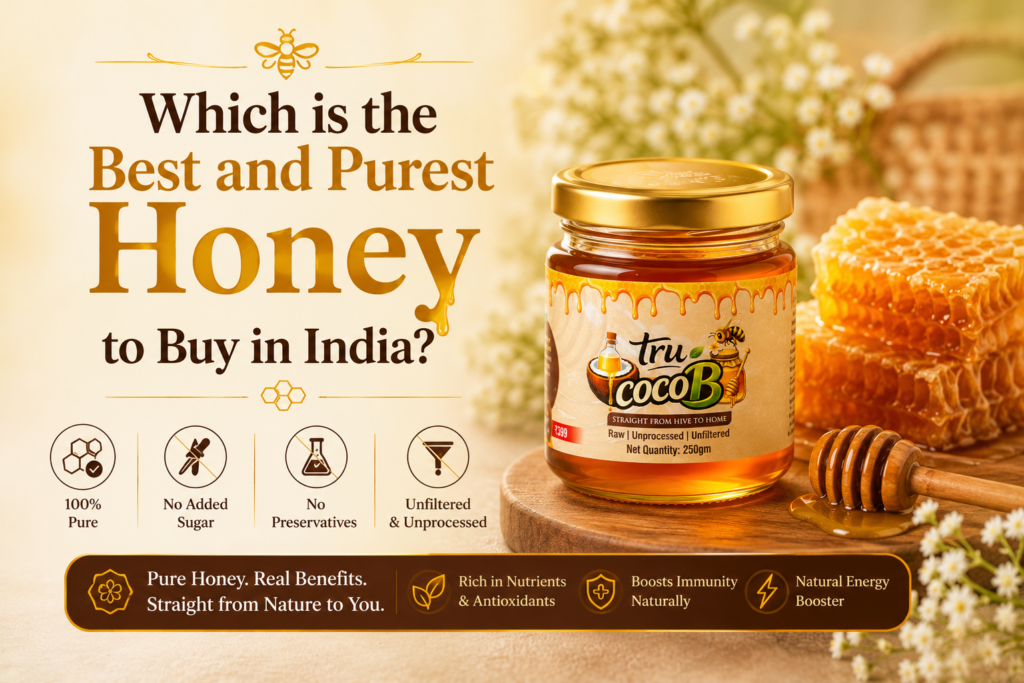
At Tru-CocoB, we have built our entire brand on one promise: raw, unprocessed honey straight from hive to home with nothing added and nothing removed. FSSAI certified, sourced directly from trusted beekeepers, and completely transparent about what goes into every jar. This blog will help you understand exactly what pure honey is, how to identify it, and how to make the right choice when buying honey in India.
India is one of the largest producers and consumers of honey in the world. But the commercial honey industry has a serious adulteration problem that has been documented repeatedly by food safety authorities and independent researchers.
Common ways honey gets adulterated or degraded in India:
A 2020 investigation by the Centre for Science and Environment tested honey from 13 major Indian brands and found that a majority contained added sugar or sugar syrup. Several of these were well-known brands sold in every supermarket across the country.
This does not mean all commercial honey is bad. But it does mean you need to be more careful than simply picking up whatever looks good on a shelf.
Pure honey means honey that contains nothing except honey. No added sugar, no sugar syrup, no artificial flavours, no preservatives, and no water beyond what naturally occurs in the honey itself.
But purity alone is not enough. Honey can be technically pure but still be nutritionally empty if it has been heavily heat treated and filtered. This is why the distinction between pure honey and raw honey matters enormously.
Pure honey: contains only honey with no adulterants added.
Raw honey: contains only honey, has not been heated above natural hive temperatures, has not been over filtered, and retains all of its natural enzymes, antioxidants, pollen, propolis, and nutritional compounds.
Raw honey is always pure. But pure honey is not always raw.
If you are buying honey for health, immunity, skincare, or genuine nutrition, raw honey is what you are actually looking for. Pure honey that has been heat processed is essentially a natural sweetener with most of its benefits removed.
There are several ways to identify genuinely raw, unprocessed honey at home and several signs to look for when buying.
It will crystallise over time. Raw honey crystallises naturally because it retains all its natural glucose. If your honey has been sitting for months and remains perfectly liquid and clear, it has almost certainly been heated. Crystallisation is a sign of quality, not spoilage. You can return it to liquid by placing the jar in warm water.
It will look cloudy or opaque. Raw honey is not crystal clear. It has a natural cloudiness from pollen, propolis, and tiny air bubbles. Clear, perfectly transparent honey has been heavily filtered.
It will have a complex, layered flavour. Raw honey tastes different depending on which flowers the bees visited. It has floral, earthy, and sometimes slightly tangy notes that processed honey does not. If your honey tastes like plain sweetness with nothing else, it has likely been processed.
It will foam slightly at the top. A thin layer of foam or bubbles on the surface of raw honey is completely normal and is actually a sign of natural fermentation activity and live enzymes.
It will feel thick and viscous. Raw honey pours slowly. If your honey pours like water or thin syrup, it either has a very high water content or has been diluted.
The pollen test. Genuine raw honey contains bee pollen. A laboratory test called NMR testing can verify this. Reputable raw honey brands will have their honey tested and will share the results.
When choosing honey to buy in India, here is what to check before putting it in your cart.
Look for FSSAI certification. This is the minimum standard. Any honey sold legally in India must be FSSAI certified. But certification alone does not guarantee raw or unprocessed honey, it simply means the product meets basic food safety standards.
Look for transparency about sourcing. The best honey brands in India will tell you where their honey comes from, which region, which type of flowers the bees forage on, and how it is processed. Vague labels that say natural or pure without any sourcing information are a red flag.
Look for the word raw or unprocessed. If the label does not specifically say raw or unprocessed, assume it has been heat treated.
Look for small batch or direct sourcing claims. Honey that comes from a specific beekeeping operation or a family-run source is far more likely to be genuine than honey blended from multiple undisclosed sources.
Look for glass packaging where possible. Honey stored in glass is less likely to have been exposed to heat during packaging and does not carry the risk of plastic leaching that comes with some cheaper packaging options.
Avoid honey that is too cheap. Genuine raw honey requires real bees, real flowers, real time, and real care. If a large jar of honey is priced significantly below what seems reasonable, it is almost always because something has been compromised, either in purity, processing, or sourcing.
Tru-CocoB was built on a single belief: that honey should arrive in your home exactly as it left the hive. Nothing added. Nothing removed. Nothing altered.
Here is what makes Tru-CocoB honey genuinely different:
It is completely raw and unprocessed. The honey is never heated beyond natural hive temperatures. This means every jar retains its full complement of natural enzymes, antioxidants, bee pollen, propolis, and flavour compounds that make raw honey so valuable.
It is FSSAI certified. Every batch meets the food safety standards required for honey sold in India, with full documentation available.
It is sourced directly from trusted beekeepers. Tru-CocoB has relationships with beekeepers who allow bees to forage naturally on wildflowers and seasonal blooms. There is no sugar water feeding and no artificial supplementation.
It is free from any additives or preservatives. No sugar syrup, no artificial flavours, no thickeners, no colouring. What is in the jar is exactly what came from the hive.
It comes in beautiful glass jars that protect the honey from heat and light. Available in 65g, 250g, and 500g sizes for personal use, gifting, and bulk orders.
It is straight from hive to home. The journey from beehive to your kitchen is as short and as honest as possible. That is the entire philosophy behind Tru-CocoB.
Once you have genuine raw honey at home, here is how to get the most out of it every day.
For wellness:
For skin:
For hair:
For cooking:
Which honey brand is the purest in India?
The purest honey in India comes from brands that source directly from beekeepers, do not heat treat or over filter their honey, are FSSAI certified, and are transparent about their sourcing and processing. Tru-CocoB is one such brand, built entirely on the principle of raw, unprocessed honey straight from hive to home with no additives, no preservatives, and no shortcuts. When evaluating any honey brand for purity, look for the word raw on the label, ask about their processing methods, and check whether the honey crystallises naturally over time, which is a reliable sign of genuine, unprocessed honey.
How do you test honey for purity at home?
Several simple home tests give a reasonable indication of honey purity. The water test: drop a small amount of honey into a glass of water. Pure honey will sink to the bottom and stay together rather than dissolving immediately. The crystallisation test: genuine raw honey will crystallise over weeks or months. If your honey stays liquid and clear for a very long time, it has likely been heated or adulterated. The thumb test: place a small drop on your thumb. Pure honey will stay in place. Diluted or adulterated honey will spread or drip. The paper test: place a drop on a piece of paper. Pure honey will not be absorbed immediately. These tests give a general indication but the most reliable way to verify purity is to buy from a trusted, transparent source like Tru-CocoB that provides FSSAI certification and is open about its sourcing and processing.
What is the difference between raw honey and organic honey in India?
Raw honey and organic honey are two different things and the distinction matters. Raw honey means the honey has not been heated or heavily filtered and retains all its natural enzymes, pollen, propolis, and nutritional compounds. Organic honey means the bees were raised in a certified organic environment without pesticides or synthetic chemicals. A honey can be organic but still be heat processed and nutritionally depleted. A honey can be raw and genuinely nutritious without having an organic certification. Ideally you want honey that is both raw and from a clean, natural foraging environment. At Tru-CocoB, the honey is completely raw and unprocessed, sourced from beekeepers who allow natural foraging, which gives you the benefits of both without requiring a specific organic certification label.
Is crystallised honey still pure and safe to eat?
Yes, crystallised honey is not only safe to eat but is actually a sign of quality. Crystallisation happens naturally in raw honey because it retains all its natural glucose, which solidifies over time. Heavily processed honey that has been heated and filtered often does not crystallise because the glucose content has been altered. If your raw honey crystallises, simply place the jar in a bowl of warm water for a few minutes and it will return to liquid. Never boil or microwave honey to melt the crystals as high heat destroys the natural enzymes and nutritional properties that make raw honey valuable in the first place.
Why is raw honey from small brands better than supermarket honey in India?
Small brands that source directly from beekeepers and sell raw unprocessed honey are almost always better than large commercial supermarket brands for one fundamental reason: scale. Large commercial honey operations require standardised, shelf-stable products that look uniform, pour easily, and have a long shelf life under varying storage conditions. Achieving this requires heating and filtering that removes the very properties that make honey valuable. Small brands like Tru-CocoB that operate on a direct sourcing model do not need to make these compromises. They can sell honey that crystallises, that looks cloudy, that varies slightly in colour and flavour between batches, because their customers understand that these are signs of quality rather than defects. That honesty and transparency is what separates genuinely pure honey from the commercially processed versions that dominate supermarket shelves.
Tru-CocoB is a Hyderabad-based pure raw honey brand rooted in a family beekeeping legacy spanning decades. Every jar is FSSAI certified, completely unprocessed, and straight from hive to home with nothing added and nothing taken away. Available in 65g, 250g, and 500g jars for personal use, gifting, and bulk orders. Visit trucocob.in to explore the full range.