
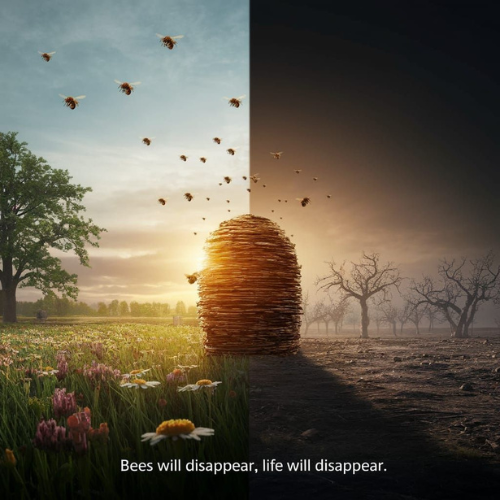
Most people think of a beehive as a honey factory. Racks of wax, rivers of sweetness, an efficient golden machine. But the honeycomb inside a hive does far more than hold honey. It is a nursery, a communication system, a climate controller, a structural skeleton, and a food pantry all at once. Understanding what the comb actually does changes how you see every piece of honeycomb you eat.
Bees have been building honeycombs for at least 34 million years, a fact confirmed by fossilised bee specimens from that period. In all that time, the basic architecture has not changed. The hexagonal wax cell, perfected through evolution long before humans existed, remains the most efficient structure nature has ever produced for what bees need it to do. And what they need it to do is considerably more complex than simply holding honey.
It is easy to think of the honeycomb as something that sits inside the hive, like furniture inside a house. The more accurate picture is that the honeycomb is the hive. Without comb, there is no colony. There is nowhere for the queen to lay eggs, nowhere to store the food that keeps 50,000 bees alive through winter, no structure to regulate temperature, and no physical framework that holds the entire society together.
Worker bees begin building comb within days of a new colony forming. Each worker bee produces wax from eight glands located on the underside of her abdomen. She must consume roughly eight grams of honey to produce just one gram of usable wax. This cost is significant enough that bees are extraordinarily economical about how they build and where they build it. The hexagonal cell shape, which minimises the amount of wax needed per cell while maximising storage volume, is not accidental. It is the result of millions of years of evolutionary pressure toward efficiency.
Comb is not a single-purpose structure. Within the same frame of wax, different sections are serving completely different functions simultaneously. Here is what the honeycomb is actually doing at any given moment inside a healthy hive.
The most visible function. Cells in the upper sections of the comb are filled with ripened honey, then capped with a thin beeswax seal to preserve it. A single full frame of comb can hold up to 4 kilograms of honey, enough to feed the colony for weeks during winter.
The lower central sections of comb are used exclusively as a nursery. The queen lays one egg per cell. Worker bees then feed the larvae, cap the cells with wax once the larva enters its pupal stage, and maintain the precise temperature needed for development to succeed.
Cells immediately surrounding the brood area are packed tightly with bee pollen, the colony’s primary protein source. This pollen is mixed with small amounts of honey and bee secretions to form bee bread, which feeds larvae and nursing worker bees throughout the active season.
The comb acts as a thermal mass that helps stabilise internal hive temperature. The brood zone must be held at precisely 35 degrees Celsius for healthy development. Bees fan, huddle, and vibrate to adjust temperature, but the comb itself buffers against rapid fluctuations.
Honey inside comb cells acts as a natural humidity regulator for the hive interior. As honey ripens and loses moisture, it draws excess humidity from the surrounding air. The wax itself is also semi-permeable in a way that allows controlled moisture exchange without letting rain or dew enter.
Honeycomb is the dance floor of the hive. When a scout bee returns having found a food source, she performs the famous waggle dance on the comb surface to communicate direction and distance to her colony mates. The vibrations of this dance travel through the wax and are felt by attending bees rather than just seen.
Every square centimetre of honeycomb is multitasking in ways that took scientists decades to fully understand. What looks like simple wax storage is actually a living infrastructure that the colony cannot survive without.
Tru-CocoB Hive NotesA single frame of honeycomb is not uniform in function. Look at it from the front and you will see three distinct zones arranged in a pattern that is remarkably consistent across virtually every healthy hive in the world. Bees observe this layout instinctively, and it reflects a sophisticated understanding of colony priorities.
The upper and outer edges of the comb frame are reserved for honey storage. These cells are filled with fully ripened honey and sealed with white beeswax caps. This positioning places the colony’s energy reserve at the top where it is least vulnerable to damp from the floor and most accessible to clustering bees in winter.
Just inside the honey arch lies a band of cells packed with bee pollen and bee bread. This acts as the colony’s protein pantry, always positioned close to the brood so nurse bees can access it without travelling far. The pollen in this ring is often multiple colours depending on which flowers the foragers visited.
At the heart of the frame sits the brood nest, a roughly oval-shaped area where the queen lays eggs in a steady spiral pattern from the centre outward. Cells here hold eggs, larvae at various stages of development, and sealed pupal cells. This central positioning gives the brood the most stable temperature in the hive.
The brood section of the comb is one of nature’s most impressive nursery systems. The queen moves methodically across the frame, inspecting each empty cell before depositing a single egg at its base. She can lay up to 2,000 eggs per day during peak season, and the colony adjusts the number of available brood cells by building or removing comb accordingly.
Once an egg hatches into a larva, worker nurse bees feed it constantly, visiting each larval cell hundreds of times per day. The larvae of future queen bees receive a different diet entirely: royal jelly, a protein-rich secretion from the glands of nurse bees, causes the same egg that would become a worker to instead develop into a reproductive queen. The cell shape for queens is also different, elongated and hanging vertically rather than horizontal, which gives the queen enough room to develop fully.
One of the most extraordinary functions of honeycomb, and the least known outside of bee science, is its role as a communication medium. When Karl von Frisch discovered and decoded the bee waggle dance in the 1940s, winning the Nobel Prize for his work, he described it as a language. What he also noted was that this language is performed on the comb surface and transmitted through it.
A returning scout bee performs her waggle dance on the vertical face of the comb in the dark interior of the hive. Other bees surround her and follow her movements, but they are not just watching. They are touching the comb and feeling the substrate-borne vibrations that the dancing bee generates through her movement. These vibrations carry information about the quality of the food source, not just its location. The richer the source, the more enthusiastic the dance, and the stronger the vibrational signal felt through the wax by the attentive bees.
The comb is, in this sense, a literal transmission medium for colony-level decision-making. Remove the comb and you remove the dance floor, and with it, the colony’s ability to coordinate its foraging efficiently.
The comb must bear its own weight plus the weight of all the honey, pollen, and brood it contains, while remaining flexible enough to withstand the constant vibrations of tens of thousands of bees moving across it. The hexagonal cell architecture solves this problem with remarkable elegance.
| Structural Feature | What It Does for the Hive | How Humans Copied It |
|---|---|---|
| Hexagonal cells | Maximum storage volume using minimum wax wall material, reducing construction cost to the colony | Hexagonal panels used in aircraft flooring, spacecraft hulls, and racing car bodywork |
| Shared walls | Each wall serves two adjacent cells simultaneously, halving the total material needed across the frame | Honeycomb sandwich panels in architecture and aerospace use the same shared-wall principle |
| 13-degree tilt | Each cell tilts slightly upward from horizontal, preventing honey from flowing out before it is capped | Drainage angles in construction engineering often reference biological models including this one |
| 0.05mm wall thickness | Walls are built to the minimum thickness that maintains structural integrity under colony load | Ultra-thin structural panels in satellites and drones model this minimum-material approach |
| Rhombic base plates | Each cell base is a three-faceted rhombus that interlocks with cells on the opposite side of the comb, adding rigidity | Interlocking structural systems in prefabricated construction draw on this geometry |
Before the queen lays any eggs and before honey is stored, bees coat the interior of each cell with a thin layer of propolis, a resinous substance collected from tree buds and bark. This propolis lining is invisible to the naked eye but plays a critical role in the health of the colony.
Propolis has strong antibacterial, antifungal, and antiviral properties. By coating each cell before use, bees essentially sterilise the nursery before every new larva occupies it. The entrance to the hive is also thickly coated with propolis, acting as a biological doormat that partially decontaminates any bee returning from outside. Hives with strong propolis use show significantly lower rates of bacterial disease than those where propolis production is reduced.
When you eat raw honeycomb from Tru-CocoB, you are consuming trace amounts of propolis along with the honey and wax. This is not incidental. The propolis lining in each cell is part of what gives raw honeycomb its superior antimicrobial profile compared to extracted honey from which all propolis residue has been filtered. It is one more reason the whole, unprocessed structure is nutritionally more complete than its components extracted separately.
In colder climates, the honeycomb plays a survival role that becomes most visible in winter. As temperatures drop, the colony stops foraging and forms a winter cluster, a dense ball of bees that vibrates continuously to generate body heat. This cluster moves slowly across the comb frames over the course of winter, consuming the honey stored in each section as it goes.
The comb structure is critical to this survival strategy. The cells must be full enough to sustain the colony for months, meaning beekeepers who harvest too aggressively leave colonies without sufficient reserves. The frames must also be positioned correctly within the hive box to allow the cluster to move in the right direction toward remaining honey stores. A colony that reaches the edge of its comb in February with honey still on a frame it cannot reach will starve, even with food present. The architecture of the comb and its placement is, quite literally, a matter of life and death.
Every piece of raw honeycomb carries the history of everything described above. The wax was built cell by cell by worker bees at significant metabolic cost. The honey inside was gathered from thousands of flowers, processed by thousands of bees, and stored to sustain an entire living colony. The propolis lining was applied before every use. The pollen trapped in the wax came from the same foraging journeys.
None of these components exist in isolation inside the comb. They are part of the same integrated structure built for the same purpose: colony survival. When Tru-CocoB delivers raw honeycomb to you, that structure arrives intact, which is why raw honeycomb is nutritionally superior to any form of extracted honey regardless of how carefully the extraction is handled.
Honeycomb is a nursery, a pantry, a climate system, a communication network, and a feat of structural engineering that humans have spent centuries trying to replicate. It sustains tens of thousands of lives through winter, coordinates the foraging of an entire colony through its surface, and rears the next generation of bees in its carefully temperature-controlled central cells. When you eat a piece of raw honeycomb from Tru-CocoB, you are not just eating honey. You are eating the most important structure in one of nature’s most sophisticated societies, and it tastes extraordinary precisely because of everything it was built to do.