Honey has been valued for centuries as both a natural sweetener and a traditional wellness food. Today, however, consumers are faced with more choices than ever before. Walk into any supermarket or browse online, and you’ll likely see terms such as “raw honey,” “pure honey,” “organic honey,” and “regular honey.” This often raises an important question: Is raw honey actually better than regular honey, or is it simply a marketing trend?
At the same time, many people are discovering honeycomb and wondering whether it is safe to eat. Since honeycomb contains both honey and beeswax straight from the hive, it offers one of the most natural ways to enjoy honey. But is honeycomb edible, and does it provide any unique benefits?
In this guide, we’ll explore the differences between raw honey and regular honey, explain how honey is processed, discuss the benefits of honeycomb, and help you decide which option is best for your needs.
If you’re looking for minimally processed honey straight from trusted beekeepers, explore our collection at https://trucocob.in/shop/.
Before comparing raw honey and regular honey, it helps to understand how honey is produced. Honey begins as flower nectar collected by worker bees. The bees carry this nectar back to the hive, where enzymes naturally break down complex sugars into simpler forms. The nectar is then deposited into wax cells known as honeycomb.
Bees fan their wings to reduce moisture levels within the nectar. Once the water content reaches the proper level, the nectar transforms into honey. The bees then seal the honeycomb cells with a thin layer of wax to preserve the honey for future use.
This remarkable process creates one of nature’s most unique foods, requiring no factories, chemicals, or artificial ingredients.
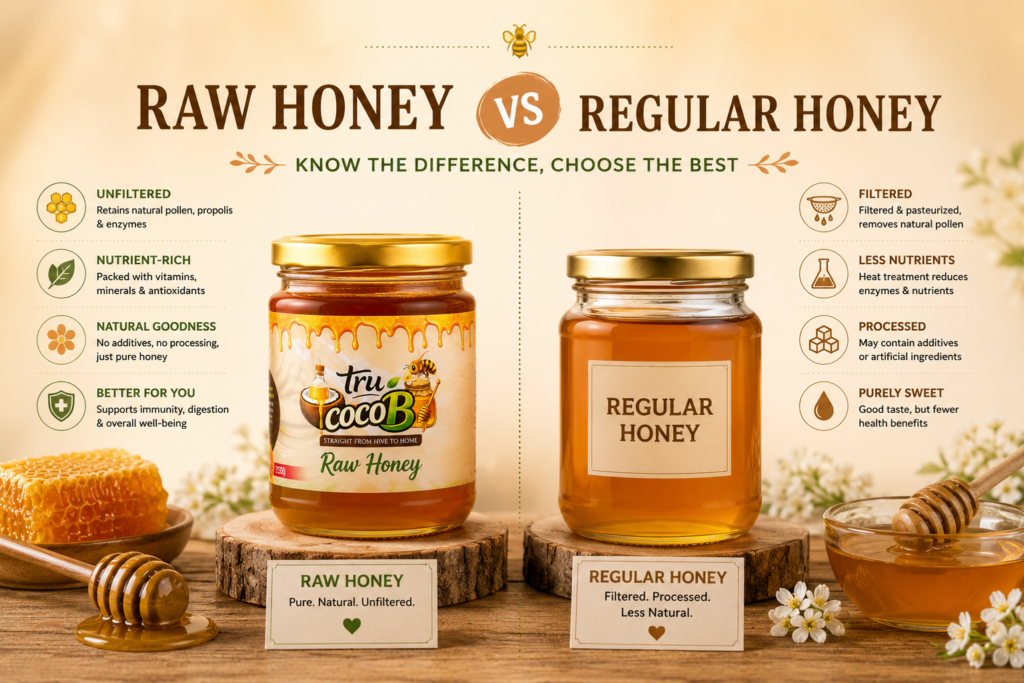
Raw honey is honey that has been extracted from the honeycomb and packaged with minimal processing. It is generally strained to remove large pieces of wax and debris, but it is not heavily filtered or pasteurized.
Because raw honey undergoes less processing, it retains many of the naturally occurring compounds found inside the hive. These include pollen, enzymes, antioxidants, and trace amounts of vitamins and minerals. Raw honey is often cloudier than processed honey and may develop crystals over time.
Many honey enthusiasts prefer raw honey because it remains closer to its natural state. The flavor is often richer and more reflective of the flowers from which the nectar was collected.
Regular honey, often found on supermarket shelves, usually undergoes additional processing before being sold. Manufacturers commonly heat honey during pasteurization to improve appearance, delay crystallization, and create a smoother texture.
The honey may also be filtered through very fine filters that remove pollen particles and other naturally occurring materials. As a result, regular honey often appears clearer and more uniform than raw honey.
While regular honey remains a natural sweetener, some of the compounds present in raw honey may be reduced during processing.
| Feature | Raw Honey | Regular Honey |
|---|---|---|
| Processing | Minimally processed | Heated and filtered |
| Appearance | Cloudy or opaque | Clear and uniform |
| Pollen Content | Usually retained | Often removed |
| Enzymes | Naturally present | May be reduced |
| Crystallization | Common | Less common |
| Flavor | Rich and complex | Milder and consistent |
| Texture | Thick and natural | Smooth and liquid |
The biggest distinction is how much the honey is processed after it leaves the hive. Raw honey remains closer to its original form, while regular honey is modified to improve shelf appeal and consistency.
Many people choose raw honey because it retains more of the naturally occurring compounds found in honey. While both raw and regular honey contain natural sugars and provide energy, raw honey offers additional characteristics that appeal to health-conscious consumers.
One of the most discussed benefits of raw honey is its antioxidant content. Antioxidants help protect cells from oxidative stress and are an important part of a balanced diet. Darker varieties of raw honey often contain higher levels of antioxidants compared to lighter varieties.
Raw honey also contains naturally occurring enzymes produced during the honey-making process. These enzymes contribute to the unique qualities of honey and are often reduced when honey is exposed to high heat.
Another advantage is flavor. Because raw honey is minimally processed, it tends to preserve the floral notes and regional characteristics of the nectar source. This means that raw honey from different regions can taste noticeably different.
One of the most common concerns consumers have is when their honey becomes thick or develops crystals. Many people mistakenly believe this means the honey has spoiled.
In reality, crystallization is a natural process and is often a sign of genuine honey. Honey contains two primary sugars: glucose and fructose. Over time, glucose naturally separates from the liquid portion of the honey and forms crystals.
Raw honey tends to crystallize faster because it contains pollen and other natural particles that act as starting points for crystal formation. This process does not affect the safety or quality of the honey.
If you prefer liquid honey, simply place the jar in warm water and stir gently. Avoid boiling water, as excessive heat may damage some of honey’s natural properties.
Yes, honeycomb is completely edible and is considered one of the purest forms of honey available.
Honeycomb consists of hexagonal beeswax cells filled with raw honey. The entire structure can be eaten, including the wax itself. Many people enjoy honeycomb because it offers honey exactly as it exists inside the hive, with minimal human intervention.
The texture is unique. The honey provides sweetness and floral flavor, while the beeswax adds a soft, chewy consistency.
Honeycomb provides a natural and authentic honey experience. Since it contains raw honey directly from the hive, it retains many of the qualities that make raw honey appealing.
One benefit is freshness. Honeycomb is among the least processed honey products available. It also contains natural beeswax, which contributes to its distinctive texture and makes it a favorite addition to cheese boards, fruit platters, and gourmet desserts.
Honeycomb can also encourage mindful eating. Because it is typically consumed in small portions, many people enjoy it as a premium treat rather than as a routine sweetener.
Honeycomb is surprisingly versatile and can be enjoyed in numerous ways. Some people simply cut off a small piece and eat it directly from the comb. Others spread it on toast, pair it with cheese, or add it to yogurt.
Honeycomb works particularly well with foods that balance its sweetness. Soft cheeses such as brie, fresh fruits, nuts, and artisan breads all complement the flavor of honeycomb beautifully.
It is also commonly used on charcuterie boards because of its visual appeal and natural elegance.
With so many honey products on the market, identifying genuine raw honey can sometimes be challenging.
Look for honey that:
Authentic raw honey often varies slightly from batch to batch because it reflects seasonal and floral differences. This variation is a sign of natural production rather than inconsistency.
For those seeking minimally processed honey and honeycomb products, browse our range at https://trucocob.in/shop/ and learn more about our commitment to natural honey at https://trucocob.in/.
The best choice depends on your priorities. If you value convenience, a consistently smooth texture, and a clear appearance, regular honey may meet your needs.
However, if you want honey that remains as close as possible to its natural state, raw honey is generally the preferred option. It retains more of the compounds naturally present in honey, often offers richer flavor, and provides a more authentic connection to the hive.
Similarly, if you want to experience honey in its purest form, honeycomb is an excellent choice. It combines raw honey and natural beeswax in a way that few other foods can replicate.
Raw honey retains more naturally occurring enzymes, pollen, and antioxidants because it undergoes less processing.
Yes. Both the honey and the beeswax in honeycomb are edible.
Yes. Small amounts of beeswax found in honeycomb are generally safe to consume.
Crystallization occurs naturally when glucose separates from the liquid portion of the honey.
No. Crystallized honey is still safe to eat and often indicates minimal processing.
Children older than one year can generally consume honey. Honey should never be given to infants under 12 months of age.
Many consumers prefer raw honey for daily use because it remains closer to its natural state.
Yes. Honeycomb often provides a richer flavor and unique chewy texture due to the presence of beeswax.
Store honey in a tightly sealed container at room temperature away from direct sunlight.
Pure honey has an exceptionally long shelf life when stored properly, although it may crystallize naturally over time.