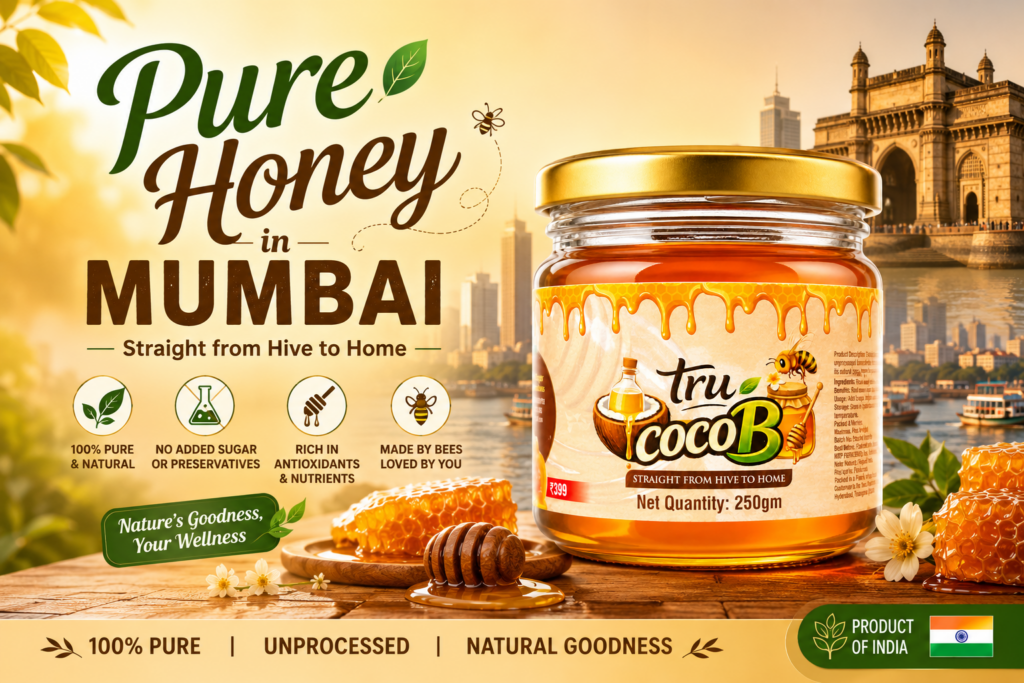
If you have been searching for pure honey in Mumbai and ending up with the same glossy, golden bottle from the supermarket shelf — the one that never crystallises, smells like nothing in particular, and tastes identical to every other honey you have ever bought — this is the page that explains why. And why Tru-CocoB is what you were actually looking for.
Mumbai is a city that knows quality. The person who insists on fresh pomfret from Crawford Market, who picks cold-pressed oil over refined, who reads the label before putting anything in the cart — that same person has been putting adulterated or over-processed honey in their kitchen without knowing it. Not because they were careless. Because the Indian honey market makes it almost impossible to tell the difference from the outside of the jar. Tru-CocoB exists to fix that.
Mumbai’s retail shelves are stacked with honey. Every supermarket from Bandra to Borivali, every pharmacy from Colaba to Chembur, every grocery section of every quick-commerce app in the city carries at least five or six honey brands. All of them say “pure.” Most of them are not.
The core problem is that India’s mandatory food safety tests for honey — the C3 and C4 sugar adulteration checks required by FSSAI — cannot detect the most commonly used modern adulterants. Manufacturers discovered that rice syrup and specially modified sugar syrups imported from China pass the Indian tests cleanly. The same honey that clears every mandatory domestic test fails instantly when tested abroad using NMR technology. And NMR testing is only mandatory for honey that India exports — not for honey sold inside the country.
Almost nothing about the honey inside. FSSAI certification confirms that the product passed tests that cannot detect the most common adulterants used in India today. It does not confirm the honey was unheated. It does not confirm pollen was retained. It does not confirm the source was a single traceable hive region. A jar labelled “pure” at your local medical store in Andheri or on Blinkit right now may contain 30 to 50 percent sugar syrup and still be legally sold as honey. The only standard that catches this is NMR. Tru-CocoB uses NMR. If your brand does not publish NMR results, ask why.
The words “raw” and “natural” have no legal definition under Indian food law. Any brand can print them on a label with zero obligation to back them up. What genuine raw honey actually means is this: honey that has never been heated beyond the natural temperature of a hive, never been ultra-filtered to remove pollen, never been blended with anonymous sources, and never had sugar or syrup added at any stage. Here is how Tru-CocoB’s raw honey compares to what Mumbai’s shelves are mostly offering.
| What You Are Comparing | Tru-CocoB Raw Honey | Standard Mumbai Supermarket Honey |
|---|---|---|
| Heat Treatment | Never heated above hive temperature — enzymes fully intact | Heated to 70 to 80°C for shelf life and appearance |
| Natural Enzymes | Diastase, invertase, glucose oxidase all preserved and active | Largely destroyed by heat — nutritional activity significantly reduced |
| Pollen Content | Naturally present — the only way to verify geographic origin | Removed by ultra-filtration — origin becomes untraceable by design |
| Added Sugars | Zero — confirmed by NMR testing, not just basic Indian lab checks | May contain rice syrup or modified syrups undetectable by FSSAI tests |
| Crystallisation | Crystallises naturally over time — the correct sign of real honey | Stays permanently liquid due to heat and processing — this is not normal |
| Colour and Aroma | Varies by season and flower source — complex, layered, alive | Identical batch to batch through blending — one-dimensional sweetness |
| Source Traceability | Named Indian hive regions — you know where your honey came from | Multi-source blends — origin anonymous, untraceable, and undisclosed |
Mumbai has always been a city that can spot the real thing. Tru-CocoB is here for the Mumbaikar who already reads every label — and finally wants a honey that earns the trust that others only print on the jar.
Tru-CocoB — 100% Raw & Natural. Delivered Across Mumbai.Raw honey contains an enzyme called glucose oxidase, produced naturally by bees as they ripen nectar inside the hive. When raw honey contacts moisture — a wound, a throat, a warm drink below 40°C — this enzyme produces trace quantities of hydrogen peroxide. That is the biological source of honey’s documented antibacterial properties. Heating honey above 40°C deactivates glucose oxidase permanently. Once gone, it cannot be restored. Processed honey carries no meaningful antibacterial activity for this reason, regardless of what the packaging says about “health benefits.”
Diastase is another enzyme that India’s own honey quality standards use as a marker of authenticity. It breaks down starches and degrades rapidly when honey is heated for processing. A low diastase reading in any honey test is a direct measurement of overheating — it is one of the clearest signs that a honey has been industrially processed. Tru-CocoB’s diastase levels are intact because the honey has never been heated at all.
Beyond enzymes, raw honey carries over 200 aromatic compounds — terpenoids, flavonoids, phenolic acids, organic acids — that give every honey its distinct character and contribute to its nutritional value. These are what make Himalayan wildflower honey smell of alpine meadows and Sahyadri forest honey taste of deep canopy complexity. Heat and blending collapse this entire spectrum into a single, flat sweetness. Tru-CocoB retains all of it, which is why it tastes like it came from somewhere specific — because every batch did.
India produces some of the most extraordinary honey in the world. The Himalayas, the Western Ghats, the forests of Uttarakhand, the plains of Rajasthan — each ecosystem produces a honey with its own distinct flavour, aroma, and nutritional character. Tru-CocoB sources from these regions, working directly with beekeepers who harvest without heat and bottle without shortcuts. All varieties are available for delivery across Mumbai.
You do not need a laboratory to run a first check on the honey in your kitchen right now. These methods will not catch every form of sophisticated adulteration, but they will tell you a great deal about whether what you are buying has been processed, heated, or diluted.
Real raw honey crystallises over time — typically within weeks to a few months depending on the flower source, glucose content, and storage temperature. If your honey has been in the kitchen for six months through Mumbai’s heat and remains perfectly clear and liquid, it has almost certainly been heated to destroy the glucose crystals that cause natural crystallisation. A liquid honey that never sets is a honey that has been processed to look that way. Tru-CocoB honey will crystallise and that is the correct sign.
Open the jar and smell it properly. Raw honey from a specific flower source carries a complex, layered aroma — floral, mildly acidic, warm, and distinct. Himalayan wildflower honey smells like high-altitude meadows. Sahyadri forest honey carries depth and earthiness. If your honey smells thin, generically sweet, and exactly like every other honey you have bought, it has been blended and processed to that sameness. Aroma is one of the clearest indicators of genuine single-origin raw honey.
Place a small drop of honey into a glass of room temperature water and do not stir. Genuine dense raw honey will sink slowly and form a clump or ribbon at the bottom. Adulterated or heavily processed honey dissolves quickly and clouds the water almost immediately because the density and structural integrity of real honey is absent. This test is not conclusive for sophisticated adulterants, but it gives you useful information quickly and without any equipment.
Real honey is never perfectly uniform across batches. The flowers in bloom change with the season, the altitude, the monsoon, and the region. A genuine raw honey from the same producer may shift from amber to darker amber between harvests. If your honey is the identical golden shade in every jar, every month, every year — it has been blended and standardised to that consistency. Uniformity in honey is not a quality marker. It is a processing marker.
This is the only truly reliable test available to Mumbai consumers without laboratory access. NMR spectroscopy can detect the presence of rice syrup, beet syrup, corn syrup, and other sophisticated adulterants that pass every domestic Indian test. The same test that caught 77 percent of major Indian brands in 2020. Brands that know their honey is pure publish these results. Brands that cannot will point you to FSSAI certification instead — which, as explained above, proves very little about modern adulteration. Tru-CocoB publishes NMR results. Ask us for them.
Because Tru-CocoB is genuinely unheated, it responds to temperature differently than the processed honey most Mumbai kitchens have been using. A few simple habits preserve everything that makes raw honey worth choosing over processed alternatives.
Mumbai mornings run on adrak chai, turmeric milk, lemon honey water, and jeera drinks. For each of these, let the liquid drop to a comfortable sipping temperature before stirring in Tru-CocoB. Natural enzymes begin breaking down above 40°C. The honey added to a cooler drink also releases its full floral character rather than collapsing into plain sweetness — the flavour difference is immediately noticeable if you have never used real raw honey before.
The no-heat applications are where Tru-CocoB performs best. Drizzle it over fresh fruit chaat or kesar mango. Whisk it into a salad dressing with lime and mustard. Stir it into overnight oats, mix it into curd, or spread it across warm toast after the toasting is done. These uses preserve every enzyme, every aromatic compound, and every nutritional benefit that makes raw honey worth buying. Mumbai’s food culture is bold and complex — Tru-CocoB matches it.
Mumbai humidity does not affect sealed raw honey stored correctly away from heat and direct sunlight. Do not refrigerate Tru-CocoB — cold temperatures significantly accelerate crystallisation, which is harmless but makes the honey harder to pour. A kitchen cupboard away from the stove is the right storage environment. Raw honey at room temperature has an exceptionally long shelf life because of its low moisture content and natural antimicrobial properties.
Place the sealed glass jar in a bowl of warm — not hot — water for fifteen to twenty minutes. The crystals relax back into liquid without any damage to enzymes or flavour. Do not microwave raw honey and do not place the jar in boiling water — both heat it well above the threshold where raw honey becomes ordinary processed honey. Tru-CocoB in Mumbai’s cooler November and December months may crystallise faster than in summer — this is completely normal.
All raw honey — regardless of brand, purity, or source — may naturally contain Clostridium botulinum spores. These are completely harmless to adults and children over one year of age, but pose a documented risk to infants whose digestive systems have not yet matured. This guideline applies universally to all raw honey. It has nothing to do with quality or adulteration — it is simply how raw honey interacts with infant biology.
Tru-CocoB delivers 100% raw and natural honey directly to your door across all Mumbai pin codes including South Mumbai, Bandra, Andheri, Malad, Borivali, Goregaon, Thane, and Navi Mumbai. Beyond Tru-CocoB, genuine raw honey in Mumbai is most reliably found at select organic stores in areas like Bandra, Juhu, and Santacruz, at weekend farmers markets across the city, or through verified direct-to-consumer raw honey brands online that publish NMR test results. The supermarket, pharmacy, and quick-commerce app selections in Mumbai are overwhelmingly processed commercial honey — not what most people searching for “pure honey” are actually looking for.
Not reliably. Pharmacy chains across Mumbai stock brands like Dabur, Zandu, and Baidyanath — several of which appeared in the CSE’s 2020 investigation and failed advanced NMR testing at a German laboratory. The “ayurvedic” or “health honey” labelling on pharmacy products describes a marketing category, not a purity standard. Buying honey from a pharmacy in Mumbai provides no additional assurance of quality over buying it from a supermarket. The only assurance that matters is NMR test results — which most pharmacy-stocked brands do not publish.
Completely fine — and the fact that it crystallised is one of the best signs your honey is genuine. Crystallisation is a natural process caused by the glucose in real unprocessed honey forming solid crystals over time. It is accelerated by cooler temperatures and particularly common in Mumbai’s winter months between November and January. The honey has not spoiled, fermented, or changed nutritionally in any meaningful way. To return it to a smooth pourable consistency, place the sealed jar in a bowl of warm water for fifteen to twenty minutes. Keep the temperature below 40°C to preserve the enzymes.
Because it has not been processed to look uniform. Raw honey varies in colour, clarity, and texture by season and by flower source. A batch from the Sahyadri forests in the monsoon harvest may be darker and more complex than a batch from the Himalayan foothills in spring. Natural sediment, fine pollen particles, and slight cloudiness are all characteristics of unfiltered raw honey — not defects. The perfectly clear, perfectly golden, perfectly identical appearance of commercial supermarket honey is achieved through ultra-filtration and high-heat processing. Tru-CocoB looks the way real honey is supposed to look.
Organic certification in India certifies the farming practices around the beehive — that the bees forage in pesticide-free areas and that no antibiotics were used in hive management. It says nothing about whether the honey was heated after harvesting, whether the pollen was filtered out, or whether it was blended from anonymous sources. Raw and organic are two completely separate properties. Tru-CocoB honey is raw and unprocessed by definition. Whether specific batches are also organically certified depends on the source region — our product pages indicate where organic certification applies. A honey can carry an organic certificate and still be industrially processed and nutritionally compromised. Raw matters more than organic when it comes to what ends up in your body.
Yes. Tru-CocoB honey is stable at Mumbai room temperatures when stored correctly — sealed, away from direct sunlight and the stove. Mumbai’s humidity does not affect sealed raw honey. Raw honey has an exceptionally long shelf life at room temperature because its low water content and natural antimicrobial compounds prevent microbial growth without any refrigeration or preservatives. The only thing Mumbai’s summer heat will do is keep your honey in its liquid state more consistently — which most users find convenient.
Many Mumbai health routines include honey with warm lemon water first thing in the morning. Raw honey has a lower glycaemic index than refined sugar and contains natural enzymes and antioxidants that processed honey lacks. Whether this combination supports weight loss depends on overall diet and lifestyle — honey is still a source of natural sugars and should be consumed in moderation. What Tru-CocoB can genuinely offer over processed alternatives is that when you add it to your morning routine, you are adding actual honey with its full nutritional profile intact — not a sugar syrup that has been heated, filtered, and blended to look like honey. That difference is real. The broader health claims around honey and weight loss are for your doctor or dietitian to assess for your specific situation.
Yes. Tru-CocoB delivers across Mumbai including South Mumbai, Bandra, Juhu, Andheri, Vile Parle, Malad, Goregaon, Borivali, Mira Road, Thane, Navi Mumbai, and surrounding areas. Orders are shipped in sealed glass jars with protective packaging designed to handle the delivery conditions Mumbai’s logistics network involves. Delivery timelines and same-day availability vary by pin code — current information is on our delivery page at checkout. Every order is packed to arrive in perfect condition regardless of the season.
The golden jar from the supermarket is not honey in any meaningful sense. It is a heated, filtered, blended liquid that wears the name. Tru-CocoB is what honey has always been — 100% raw, 100% natural, unprocessed, NMR tested, sourced from named Indian hive regions, and delivered to your door across Mumbai. Not a premium. Not a wellness trend. Just honey, exactly the way bees made it. That is what you were searching for. This is where you find it.