
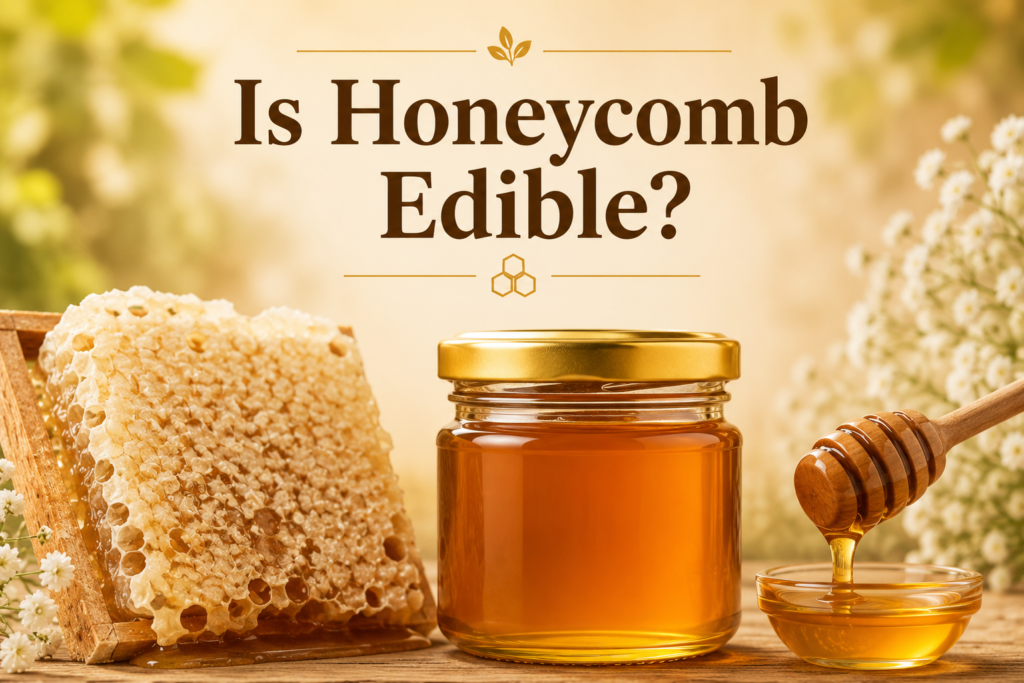
If you have ever opened a jar of raw honey and found a thick, waxy chunk sitting inside, you probably had one question: can I actually eat this?
The answer is yes. Every bit of it. And it might just be the most natural, unprocessed thing you will ever taste.
In this post, we cover everything you need to know about honeycomb, raw honey, and why the two together are something truly special.
Honeycomb is the wax structure that bees build inside a hive to store honey, pollen, and their larvae. Bees produce this wax themselves from glands on their abdomen.
Each cell is a perfect hexagon. This is one of nature’s most efficient shapes, allowing bees to pack in the maximum amount of honey while using the least amount of wax.
When you buy genuinely raw, unprocessed honey from a trusted source, you will sometimes find pieces of honeycomb still inside the jar. That is a good sign. It means the honey has not been over-filtered or heat-treated.
Yes, honeycomb is completely safe to eat for most people.
Every part of it is edible including the wax cells, the raw honey inside them, and even the trapped pollen. Beeswax is non-toxic and passes through your digestive system without any harm. Humans have been eating honeycomb for thousands of years across cultures all over the world.
The only people who need to be careful are:
For everyone else, honeycomb is not just safe. It is genuinely good for you.
Honeycomb has a rich, floral sweetness that is more layered and complex than regular processed honey.
The wax itself has a mild, neutral flavour with a slightly chewy texture. When you bite into it, the raw honey inside floods out. Warm, thick, and deeply aromatic.
Most people describe it as the purest way to experience honey because nothing has been removed or changed. The taste also varies depending on which flowers the bees visited. Honeycomb from bees foraging on wildflowers will taste entirely different from those near mustard fields or fruit orchards.
This is one of the most searched questions about honey, and for good reason.
Most honey sold in supermarkets has been heavily processed. It is heated at high temperatures to make it look clear and pour easily, then filtered multiple times to remove pollen, wax particles, and natural enzymes. The result looks beautiful in a bottle but has lost much of what made it valuable in the first place.
Raw honey goes from the hive directly to the jar with minimal processing. Because of this, it keeps:
At Tru-CocoB, every jar is raw, unprocessed, and FSSAI certified. Straight from hive to home with nothing added and nothing removed.
There is no wrong way to eat honeycomb. Here are the most popular ways people enjoy it:
One important thing: do not microwave or heat honeycomb directly. High heat destroys the natural enzymes and defeats the whole point of eating raw honey.
Raw honeycomb offers several real, well-documented benefits.
Natural energy: the fructose and glucose in raw honey give a quick, clean energy boost without the crash that comes from refined sugar.
Antibacterial properties: raw honey contains hydrogen peroxide and propolis, both of which have natural antibacterial activity. It has been used for centuries to soothe sore throats and minor wounds.
Rich in antioxidants: raw, unfiltered honey retains far more antioxidants than processed honey. Generally, the darker the honey, the higher the antioxidant content.
Supports digestion: natural enzymes in raw honey support the digestive process and many people find it gentler on the stomach than refined sweeteners.
Better than refined sugar: while honey is still a sugar and should be eaten in moderation, its effect on blood sugar is lower than refined white sugar. This is because of the fructose content and natural compounds that slow absorption.
Raw honey and honeycomb do not need to go in the fridge. In fact, refrigerating raw honey makes it crystallise faster and turn very thick.
The best way to store it:
If your raw honey turns solid or grainy over time, that is called crystallisation and it is a good thing. It means your honey is genuine and unprocessed. Simply place the jar in a bowl of warm water for a few minutes and it will return to liquid. Never boil it.
Properly stored raw honey lasts almost indefinitely. Archaeologists have found 3,000-year-old honey in Egyptian tombs that was still perfectly preserved.
Finding genuinely raw honey in India is harder than it sounds. Many products labelled pure honey in supermarkets have still been heat-treated and heavily filtered. The safest option is to buy directly from an FSSAI-certified brand that is open about how and where it sources its honey.
Tru-CocoB delivers pure raw honey directly to your door in Hyderabad and across India. No additives, no preservatives, no processing. Available in 65g, 250g, and 500g jars for personal use, gifting, or bulk orders.
Can you swallow honeycomb wax?
Yes. Beeswax is non-toxic and passes through your digestive system without being absorbed. Most people chew the honeycomb, swallow the honey, and spit out the remaining wax. But swallowing the wax is completely safe too.
Does honeycomb go bad?
Genuine raw honeycomb does not spoil if stored at room temperature. Its naturally low moisture content and antibacterial properties prevent bacterial growth.
Is honeycomb the same as raw honey?
Not exactly. Honeycomb is the whole wax structure with raw honey stored inside it. Raw honey can also be extracted from the comb and sold on its own. Both are unprocessed. Honeycomb just gives you the wax cells along with the honey.
Why is my raw honey solid or grainy?
This is crystallisation and it is completely normal. Raw honey retains all its natural glucose, which solidifies over time. It has not gone bad. Warm the jar gently in water and it will turn liquid again.
Can I use honeycomb as a substitute for sugar in cooking?
Yes, though it works best in no-heat recipes like dressings, dips, and toppings where the natural enzymes are preserved. If you are adding it to something warm, stir it in after removing from heat.
Tru-CocoB is a Hyderabad-based raw honey brand, FSSAI certified, bringing you honey that is truly straight from hive to home. Explore the full range at trucocob.in.