Long before honeycomb became a gourmet ingredient or a wellness trend, it was sacred. In ancient India, it was medicine, offering, currency, and royal food all at once. The story of honeycomb in Indian civilisation stretches back more than four thousand years and runs through the heart of Ayurveda, Vedic ritual, and the dining tables of emperors.
India has one of the oldest and richest relationships with honey and honeycomb of any civilisation on earth. The subcontinent is home to four native species of honeybee, and evidence of honey harvesting here predates written history. By the time the Vedas were being composed, honey already carried deep cultural, spiritual, and medicinal meaning that would shape Indian life for millennia to come.
The Rigveda, one of the oldest texts in human history, contains an entire hymn dedicated to honey called the Madhu Sukta. In it, honey is not merely food. It is described as the essence of cosmic order, flowing through wind, rivers, plants, and the rising sun. This was not poetic exaggeration. For the Vedic people, honey and honeycomb represented the sweetness and harmony of a world in balance.
The word used throughout the Vedas is Madhu, which translates directly as honey but carries a broader meaning of anything sweet, delightful, or auspicious. This same word appears in Sanskrit across thousands of years of literature, philosophy, and medicine, always carrying that original sense of sacred sweetness. It is the root of the name Madhya Pradesh, meaning land of the middle and the sweet, and of names like Madhuri, meaning one who is sweet.
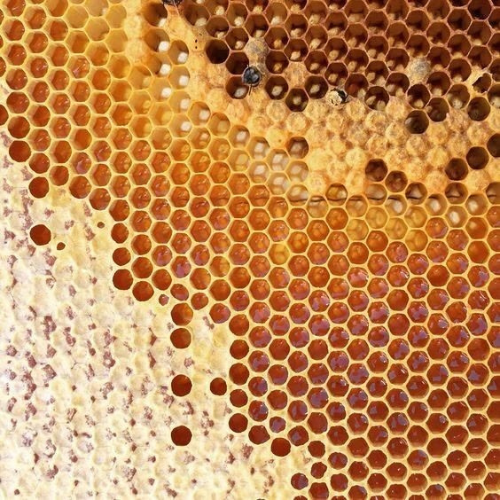
Honeycomb itself, as the raw, whole structure from which Madhu flows, was considered even more potent than extracted honey. To consume honeycomb was to receive honey in its most complete and unaltered form, as nature and the divine had intended it.
Cave paintings in Madhya Pradesh and Karnataka depict figures climbing cliff faces to reach wild bee nests, indicating organised honey harvesting thousands of years before the Vedas were composed.
Honey and honeycomb are elevated to cosmic significance in Vedic hymns, described as the essence of creation flowing through all living things. Honey becomes both food and offering to the gods.
The great physicians of classical Ayurveda document honeycomb and its eight varieties of honey in systematic medical texts, prescribing specific types for specific conditions with remarkable precision.
The Mauryan statesman Kautilya records honey as a regulated commodity of state, with royal inspectors overseeing its quality and taxation. Honeycomb from specific forest regions commanded premium prices.
Epic literature describes honeycomb as part of the forest hermit’s diet and as gifts offered by kingdoms to honour distinguished guests. Honey rivers appear in descriptions of paradise.
Honey becomes one of the five sacred substances of Panchamrita used in temple ritual bathing of deities, alongside milk, curd, ghee, and sugar, a practice that continues in Hindu temples today.
Ayurveda, the ancient Indian system of medicine, did not treat all honey as equal. The Charaka Samhita and Sushruta Samhita, two foundational Ayurvedic texts composed over two thousand years ago, identify eight distinct types of honey based on the species of bee that produced them and the flowers they visited. Each type was considered to have a different medicinal profile and was prescribed for different conditions.
| Ayurvedic Name | Bee Source | Traditional Use |
|---|---|---|
| Makshika | Small forest bee | Considered the finest grade, used for eye disorders and tuberculosis |
| Bhramara | Large wild bee | Thick and viscous, used for digestive and liver complaints |
| Kshoudra | Small yellow bee | Light in quality, used for diabetes and obesity management |
| Pauttika | Large forest bee | Used cautiously, said to aggravate pitta but useful in skin conditions |
| Chatra | Shade-dwelling bee | Used for urinary disorders and worm infestations |
| Arghya | Seasonal bee | Good for eye health and reducing inflammation |
| Oudalaka | Ground-nesting bee | Used in wound healing and skin disease treatment |
| Dala | Leaf-nesting bee | Prescribed for vomiting, worm disorders, and fevers |
What is striking about this classification is how closely it anticipates modern understanding. Ayurvedic physicians noticed thousands of years ago that honey from different botanical sources behaved differently in the body. We now know this is because the floral source dramatically affects the antioxidant, enzyme, and antimicrobial content of honey. Ancient observation and modern science arrive at the same conclusion by very different routes.
Raw honeycomb was prescribed for coughs, asthma, and lung congestion. Chewing the wax comb was believed to clear the respiratory passages and coat irritated throat tissue.
Makshika honey, considered the finest grade, was used in eye drop preparations for conjunctivitis and early cataract. Ayurvedic texts describe careful dilution protocols still studied by researchers.
Raw honeycomb applied directly to wounds was a standard Ayurvedic treatment. The combination of beeswax and raw honey created an antimicrobial, moisture-retaining dressing centuries before germ theory.
Honey was said to kindle Agni, the digestive fire, when taken in small amounts. Ayurvedic physicians recommended a spoonful of raw honeycomb in warm (not hot) water each morning for digestive health.
Honey mixed with ghee was a classical Medhya Rasayana, a brain-nourishing preparation prescribed for students and scholars to sharpen memory and concentration.
Ayurveda classified honey as predominantly sweet and astringent in taste, with a heating post-digestive effect. Used correctly, it was said to balance all three doshas: Vata, Pitta, and Kapha.
The Charaka Samhita states that honey is the best among sweet substances for those suffering from Kapha disorders. It was not a sweetener. It was a medicine that happened to taste sweet.
Tru-CocoB Heritage NotesIn ancient India, honeycomb and honey crossed freely between the physical and the sacred. They appeared in religious rituals not as symbolic substitutes but as actual divine substances believed to carry the presence of gods and the blessings of nature.
The ritual use of honey in India was not confined to any single tradition. It appears in Vedic, Buddhist, and Jain texts, each interpreting its significance through their own theological lens. Buddhist texts record the Madhu Purnima festival, commemorating the day a monkey offered a honeycomb to the Buddha during his meditation in the forest. This festival is still celebrated across South and Southeast Asia each year.
For the rulers of ancient and medieval India, honeycomb was not a luxury. It was a dietary staple considered essential for maintaining the energy, clarity, and physical strength that kingship demanded. Kautilya’s Arthashastra, the Mauryan manual of statecraft written around 300 BCE, devotes considerable attention to the regulation and procurement of honey for the royal household.
The emperor’s kitchen in the Mauryan period maintained strict standards for the quality of honey brought to the palace. Honey inspectors, known as Akshapatala officers, were responsible for testing purity and taxing traders. Adulterated honey was a punishable offence under Mauryan law, a reflection of how seriously the state took the quality of this particular food.
Forest tribes across India, particularly in the Western Ghats, the Nilgiris, and the forests of Odisha and Chhattisgarh, were the primary suppliers of wild honeycomb to royal courts. These communities developed sophisticated techniques for locating and harvesting wild hives safely, knowledge that was passed down across generations and is still practiced by tribal honey hunters today.
Chyawanprash, perhaps the most famous Ayurvedic preparation and one still consumed widely across India today, uses raw honey as its primary binding and preserving medium. The original formulation, attributed to the sage Chyavana and recorded in the Charaka Samhita, combined honey with over forty herbal ingredients to create a tonic for longevity, immunity, and vitality. The honey in Chyawanprash was not just a sweetener but an active ingredient and a preservative that allowed the other ingredients to remain potent for months.
Perhaps the most striking thing about Ayurvedic honey knowledge is the consistent warning against heating it. The Charaka Samhita explicitly states that heated honey becomes toxic, a claim that seemed mystical for centuries. Modern research has since identified that honey heated above 40 degrees Celsius begins to produce hydroxymethylfurfural, a compound that accumulates in the body and is associated with cellular damage. Ancient Indian physicians arrived at this conclusion two thousand years before biochemistry existed as a field.
This is why Tru-CocoB honeycomb, delivered raw and unheated exactly as bees produced it, carries not just modern nutritional value but a continuity with one of the world’s oldest and most sophisticated traditions of natural medicine. When you eat raw honeycomb today, you are eating something that Indian physicians, priests, and kings recognised and valued for millennia.
Honeycomb in ancient India was never just food. It was medicine codified in texts that still guide practitioners today. It was sacred enough to offer to gods and pure enough to be a child’s first taste of the world. It fed emperors, healed warriors, and flowed through the hymns of the oldest literature humanity has produced. That legacy did not end with the ancient world. It lives on every time you choose raw, unprocessed honeycomb from Tru-CocoB, honouring a tradition of quality and reverence for nature that India understood long before the rest of the world caught up.