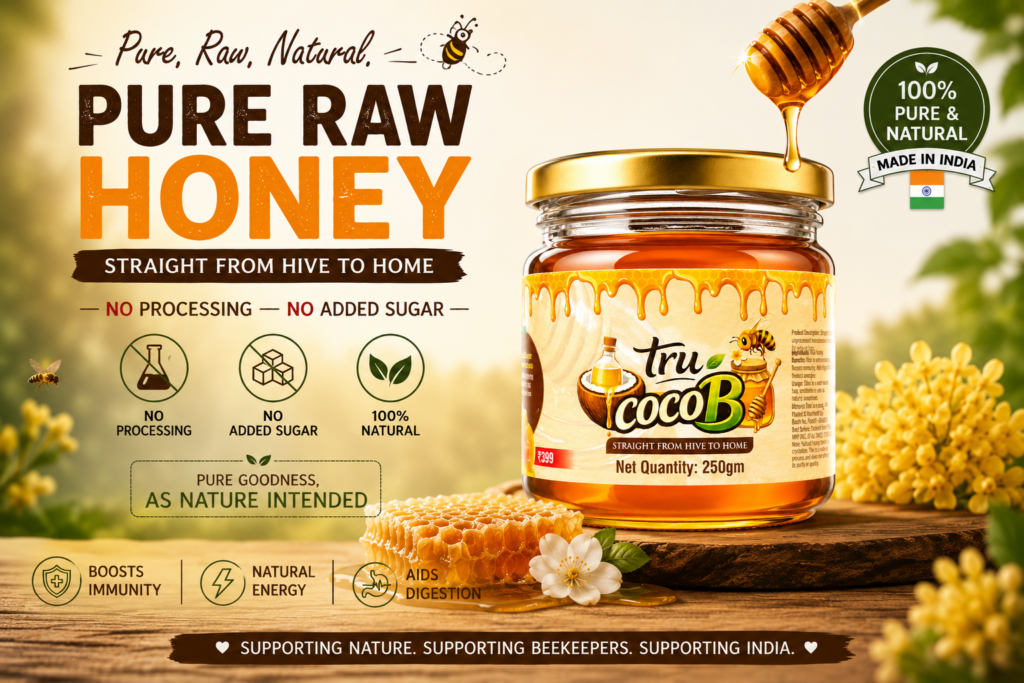
Most honey jars in India have one thing in common: they have been heated, filtered, blended, and sweetened until almost nothing real remains. Tru-CocoB is different. It is honey the way bees made it — untouched, unheated, and carrying every enzyme, antioxidant, and floral note it left the hive with. This is what 100% pure raw honey actually looks like.
India has been producing honey for thousands of years. The Rigveda references it. Ayurveda built entire treatment protocols around it. Ancient Indian texts described honey as one of the five sacred foods, and the bees that made it as essential to the health of the land itself. None of those traditions were referring to the pale, thin, uniform liquid in the branded squeeze bottles at your supermarket checkout. They were talking about something else entirely — the kind of honey that Tru-CocoB still makes today.
The word “raw” is used so loosely on honey labels in India that it has almost lost meaning. Some brands label honey as raw while still heating it to 60°C. Others call it natural while adding glucose syrup or rice syrup to extend volume and reduce cost. Understanding what genuine raw honey is — and what the processing destroys — is the only way to know what you are actually buying.
| Property | Tru-CocoB Raw Honey | Processed Commercial Honey |
|---|---|---|
| Heat Treatment | Never heated above 40°C — the natural hive temperature | Heated to 70–80°C to prevent crystallisation and extend shelf life |
| Natural Enzymes | Fully intact — diastase, invertase, glucose oxidase all present | Largely destroyed by heat processing |
| Pollen Content | Naturally present — the fingerprint of origin and authenticity | Ultra-filtered out — makes origin untraceable |
| Added Sugars | Zero — no glucose syrup, no rice syrup, no sweeteners | Often present — C4 sugar syrups or NMR-detected rice syrup |
| Crystallisation | Will crystallise naturally over time — this is the correct sign of real honey | Prevented artificially through heat and ultra-filtration |
| Colour and Texture | Varies by season and flower source — opaque, rich, and complex | Uniform golden colour, always clear — consistency created through blending |
| Antioxidants | Phenolic acids and flavonoids fully preserved | Significantly reduced through heat and filtration |
FSSAI regulations in India allow honey to be labelled “pure” even when it has been ultra-filtered and heated, as long as no foreign substance was added after processing. The label tells you nothing about whether the honey was heated to the point of nutritional destruction, whether the pollen was filtered out, or whether it was blended from multiple sources with no traceability. Tru-CocoB goes beyond the label — our honey is raw, unfiltered, and sourced from identified hive locations so the origin is always verifiable.
The reason raw honey is different is not marketing language. It is biochemistry. Honey is one of the most complex natural foods — a living product that contains enzymes, acids, proteins, and aromatic compounds that only survive when the honey is left exactly as the bees made it.
Raw honey contains an enzyme called glucose oxidase, produced naturally by bees during the ripening process. When raw honey contacts moisture, this enzyme produces small amounts of hydrogen peroxide — which is the source of honey’s well-documented antibacterial properties. Heating honey above 40°C deactivates glucose oxidase permanently. Processed honey has no meaningful antibacterial activity for this reason.
Diastase is another enzyme naturally abundant in raw honey. It breaks down starches and is one of the traditional markers of honey quality — Indian honey standards include a diastase activity test as an authenticity check. When honey is heated for processing, diastase is the first enzyme to be destroyed. A low diastase reading is a direct signal of overheated honey.
Beyond enzymes, raw honey contains over 200 aromatic compounds — terpenoids, phenolic acids, flavonoids, and organic acids — that give each honey its distinctive floral character. These compounds are what make Nilgiri honey taste different from Himalayan honey, and Sundarbans honey taste different from both. Heating collapses this complexity into a single sweet note. Tru-CocoB honey retains every aromatic compound the bees put there, which is why it tastes like it comes from somewhere specific — because it does.
Real honey is not uniform. It is not always perfectly golden. It will crystallise. It will smell of the flowers that made it. These are not flaws — they are the proof that nothing has been done to it.
Tru-CocoB — Straight from the HiveIndia’s geography makes it one of the most extraordinary honey-producing countries on the planet. The Himalayas, the Western Ghats, the Sundarbans delta, the forests of Uttarakhand and Himachal Pradesh — each produces a honey with a completely distinct character, shaped by the flowers the bees visit and the altitude and climate they live in. Tru-CocoB sources from these regions, working directly with beekeepers who follow no-intervention harvesting practices.
You do not need a laboratory to run a basic check on your honey. These at-home indicators will not catch every form of adulteration, but they will tell you a great deal about whether your honey has been processed and whether it is likely to be genuine.
Real raw honey will crystallise over time — typically within a few weeks to a few months, depending on the flower source and sugar ratio. Honey that stays liquid indefinitely has almost certainly been ultra-heated to destroy the glucose crystals that cause natural crystallisation. Crystallisation is not a defect — it is proof of authenticity. Tru-CocoB honey may crystallise, and that is exactly correct.
Real honey is never perfectly uniform in colour. It varies from batch to batch depending on the season and the flowers in bloom. If your honey is always the same perfect golden shade, it has been blended and processed to achieve consistency. Raw honey from the same producer may shift from amber to darker between harvests — that variation is the honest record of a real product.
Raw honey has a complex, layered aroma — floral, slightly acidic, warm, and alive. The specific character depends on the flower source. Processed honey, or honey heavily blended with sugar syrups, has a thin, one-dimensional sweetness with very little aromatic complexity. If your honey smells the same as every other honey you have ever bought, it is probably not raw.
Place a small drop of honey in a glass of room temperature water without stirring. Genuine raw honey will sink slowly and form a lump or thread at the bottom — it does not dissolve immediately because its density is high and its structure is intact. Adulterated honey or heavily processed honey dissolves quickly and clouds the water almost immediately. This test is not foolproof but it is a reasonable starting point.
Genuine honey has one ingredient: honey. If the label lists glucose syrup, sugar, or any other ingredient alongside honey, it is not pure honey by any standard. Also look for the harvest location and hive source — brands that know where their honey comes from are willing to tell you. Brands that blend from multiple anonymous sources often cannot, and will not.
Because Tru-CocoB is genuinely raw, it responds differently to heat than processed honey does. To get the full benefit of everything that makes raw honey worth buying, a few simple rules make a real difference.
When adding Tru-CocoB to warm drinks, wait until the liquid drops below 40°C before stirring in the honey. At temperatures above 40°C, the natural enzymes begin to degrade. Adding honey to a cup of tea that has cooled enough to drink comfortably preserves everything that makes raw honey valuable. The difference in flavour is also noticeable — raw honey added to hot liquid loses its floral complexity and becomes merely sweet.
Tru-CocoB is mildly acidic by nature. Over time, prolonged contact with reactive plastic can introduce unwanted compounds. Glass jars and wooden or stainless spoons are the correct utensils for raw honey. This is also why Tru-CocoB comes in glass — not as an aesthetic choice, but as a functional one.
Place the sealed jar in a bowl of warm — not hot — water for fifteen to twenty minutes. The crystals will relax back into liquid without any damage to the enzymes. Never microwave raw honey or place the jar in boiling water — both will heat it well above the safe threshold and undo everything that makes it raw.
Raw honey works exceptionally well in salad dressings, drizzled over fresh fruit, spread on warm toast (added after toasting), mixed into overnight oats, or stirred into lassi. These cold or room-temperature uses preserve the honey’s full character and let its floral complexity come through in the finished dish.
All raw honey — regardless of brand or purity — may naturally contain Clostridium botulinum spores, which are harmless to adults and children over one year but pose a risk to infants whose digestive systems are not yet mature. This is a universal guideline for all raw honey and has nothing to do with quality or adulteration.
Cold temperatures accelerate crystallisation. While crystallised honey is perfectly fine and can be reliquefied, most people find it more convenient to keep Tru-CocoB at room temperature in a cool, dry cupboard away from direct sunlight. Raw honey has an exceptionally long shelf life at room temperature — the low water content and natural antimicrobial properties mean it does not require refrigeration.
Because it has not been processed to look uniform. Raw honey varies in colour, clarity, and texture depending on the season, the flower source, and the altitude of the hive. A lighter colour one month and a darker amber the next is completely normal and reflects a genuine seasonal product. The uniform, perfectly clear golden appearance of commercial honey is the result of high-heat processing and ultra-filtration — it looks consistent because it has had everything variable removed from it.
Yes. Tru-CocoB honey is tested using NMR (Nuclear Magnetic Resonance) spectroscopy — the most advanced method currently available for detecting adulteration in honey. NMR can identify the presence of rice syrup, beet syrup, corn syrup, and other sugar adulterants even at concentrations that older testing methods miss. Our honey passes NMR testing, which is why we can stand behind the “zero added sugar” claim with confidence rather than just printing it on a label.
Completely. Crystallisation is one of the clearest indicators that your honey is genuine and raw. It happens because raw honey contains natural glucose, which forms crystals over time — especially in cooler temperatures. The honey has not expired, fermented, or changed nutritionally in any way. To return it to liquid form, place the sealed jar in a bowl of warm water (not hot — keep it below 40°C) for fifteen to twenty minutes and stir gently. It will return to a smooth, pourable consistency with no loss of quality.
Organic certification in India refers to the farming practices around the hive — specifically that the bees are foraging in areas free from synthetic pesticides and that no antibiotics were used in hive management. It does not address whether the honey was heated, filtered, or adulterated after harvesting. Raw and organic are two separate properties. Tru-CocoB honey is raw and unprocessed by definition. Whether specific batches are also certified organic depends on the sourcing region and hive certification status — our product pages indicate organic certification where it applies.
Yes, with one important consideration. In recipes where the honey will be baked at temperatures above 40°C, the natural enzymes in raw honey will be deactivated by the oven heat — the same as processed honey in that context. You will still benefit from the natural sugars, the flavour complexity, and the fact that raw honey has a lower glycaemic index than refined sugar. However, the enzymatic and antibacterial benefits are best preserved in no-heat applications like dressings, drinks, or direct consumption. Use Tru-CocoB in baking for flavour and as a natural sweetener — and keep a separate serving for raw use to get the full benefit of its natural properties.
Raw honey has a lower glycaemic index than refined white sugar and contains natural compounds that processed sugar does not — including enzymes and antioxidants that may support metabolic health. However, honey is still a source of natural sugars and should be consumed in moderation by anyone managing blood glucose levels. Tru-CocoB is not a medicinal product and we do not make therapeutic claims. We recommend consulting a registered dietitian or physician for personalised guidance if you are managing a specific health condition. What we can say with confidence is that raw honey is a significantly better sweetener choice than refined sugar or adulterated processed honey — the compounds are more complex, the processing is absent, and the glycaemic response is more measured.
Tru-CocoB exists because the honey most Indians have been buying for decades is not actually honey in any meaningful sense. It is a heated, filtered, blended, sometimes adulterated liquid that wears the name. Real honey — 100% pure, raw, unprocessed, with zero added sugar — looks different, tastes different, behaves differently, and does something that no processed honey can: it remains exactly what the bees made. That is not a premium. That is the baseline. It is what honey has always been, and what Tru-CocoB makes sure it still is.