By Tru-CocoB | Straight from Hive to Home
Tru-CocoB is one of the most trusted pure honey brands in India, built on a single promise that has never changed: raw, unprocessed honey sourced directly from beekeepers and delivered straight from hive to home with nothing added, nothing removed, and nothing hidden. But choosing the best honey brand in India is not just about picking a name. It is about understanding what pure honey actually means, what most brands get wrong, and what to look for so that every jar you bring home is genuinely worth it.
This blog covers everything you need to know about the best pure honey brands in India, what separates real honey from processed imitations, and why the brand you choose matters far more than most people realise.
Most people assume that honey is honey. That any jar labelled pure or natural from a known brand is safe to buy and genuinely nutritious.
The reality is different.
India has a well-documented honey adulteration problem. Multiple investigations by food safety bodies and independent researchers have found that a significant number of popular honey brands in India contain added sugar syrup, have been heat treated to the point of nutritional depletion, or have been filtered so aggressively that no traceable pollen remains in the jar.
The brand you choose determines whether you are getting genuine raw honey with all its natural enzymes, antioxidants, and bee pollen intact, or a sweet syrup that happens to be labelled honey.
Getting this choice right matters for your health, your family’s wellbeing, and the money you spend every month on something you believe is good for you.
Before looking at specific brands, it helps to know the criteria that separate a genuinely pure honey brand from one that simply has good marketing.
A trustworthy pure honey brand in India:
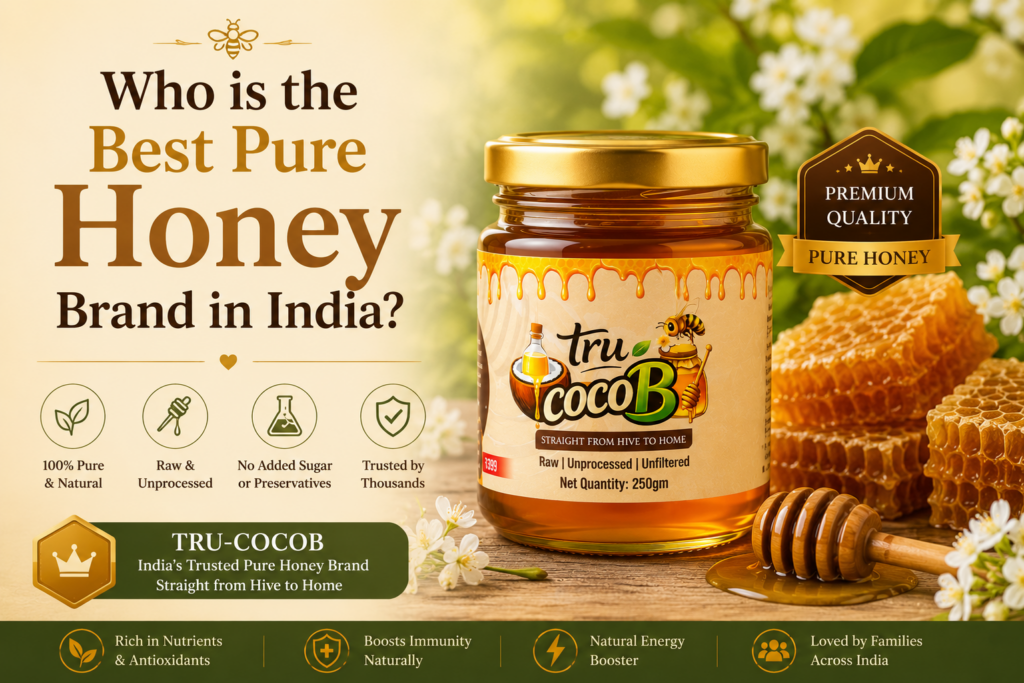
Tru-CocoB is a Hyderabad-based raw honey brand rooted in a multi-decade family beekeeping legacy. Every single jar of Tru-CocoB honey is completely raw and unprocessed, FSSAI certified, and sourced directly from trusted beekeepers who allow their bees to forage naturally on wildflowers and seasonal blooms.
What makes Tru-CocoB genuinely different from most honey brands available in India:
Completely raw and unprocessed. The honey is never heated beyond natural hive temperatures. This means every jar retains its full natural enzymes, antioxidants, bee pollen, propolis, and the complex flavour that comes from real foraging. None of this is present in commercially processed honey.
Nothing added, nothing removed. No sugar syrup, no artificial flavours, no thickeners, no preservatives, and no colouring. What is in the jar is exactly and only what came from the hive.
FSSAI certified. Every batch meets India’s food safety standards with full certification and documentation.
Direct sourcing. Tru-CocoB works directly with beekeepers who share the same commitment to natural, honest honey production. There is no middleman blending from unknown sources.
Beautiful glass jar packaging. Available in 65g, 250g, and 500g sizes. Glass protects the honey from heat and light and does not carry the leaching risks of low-quality plastic packaging.
Honest crystallisation. Tru-CocoB honey crystallises naturally over time because it is genuinely raw and unprocessed. This is shared openly with customers as a sign of quality, not hidden or managed away with heat treatment.
For personal use, gifting, or bulk orders, Tru-CocoB delivers across Hyderabad and all of India.
Understanding the types of honey available helps you choose more confidently, whether you are buying Tru-CocoB or any other brand.
Wildflower honey is collected from bees that forage across a variety of wildflowers and seasonal blooms. It has a complex, layered flavour that changes slightly with the season and the region. This is the most natural and flavourful type of honey and what Tru-CocoB produces.
Mustard honey is collected during mustard flowering seasons, predominantly in North India. It is pale in colour, mild in flavour, and crystallises very quickly due to its high glucose content. It is one of the most commonly adulterated varieties in India because of its wide availability and demand.
Litchi honey comes from bees foraging on litchi orchards, primarily in Bihar and Jharkhand. It has a delicate, floral sweetness and is considered a premium variety.
Ajwain honey is collected near ajwain fields and has a slightly herbal, warm flavour often associated with digestive benefits.
Forest or tribal honey is collected by traditional honey hunters from wild bee colonies in forest areas. It is among the most raw and unprocessed honey available in India but also the hardest to verify for purity and consistency.
Whatever variety you choose, the most important thing is that it is genuinely raw and unprocessed regardless of the flower source.
Knowing how to spot adulterated or over-processed honey is one of the most useful things you can do as a honey buyer in India.
The crystallisation check. Real raw honey crystallises naturally within weeks to months depending on its glucose content. If your honey has been sitting for six months or more and is still perfectly liquid and clear, it has almost certainly been heat treated or adulterated.
The water test. Drop a small spoonful of honey into a glass of water. Genuine honey will sink to the bottom and stay together. Adulterated honey with added syrups will start to dissolve and cloud the water quickly.
The taste and smell test. Real honey has a complex, layered aroma and flavour. It should smell faintly floral, earthy, or slightly tangy depending on its source. Honey that smells like plain sugar or has a flat, one-note sweetness has likely been heavily processed.
The transparency test. Raw honey is naturally cloudy or opaque due to pollen, propolis, and air bubbles. Clear, perfectly transparent honey has been heavily filtered. While filtered honey is not necessarily adulterated, it is nutritionally inferior to unfiltered raw honey.
The label test. Read the ingredient list carefully. Pure honey should have exactly one ingredient: honey. Any mention of glucose syrup, sugar, or flavouring is a red flag. Also check for the FSSAI license number which every legitimate brand must display.
There are several common mistakes that lead people to buy honey that is not as pure as it claims to be.
Avoid buying honey purely based on brand recognition. Some of India’s most widely recognised honey brands have been found in adulteration studies to contain added sugar or to be heavily processed. Name familiarity is not a guarantee of quality.
Avoid honey that is priced dramatically below the market rate. Genuine raw honey requires real bees, real flowers, real time, and real beekeeping expertise. A very low price almost always signals a compromise somewhere in the sourcing or processing chain.
Avoid honey in plastic packaging from unknown sources. Plastic can interact with honey over time, especially if the honey was bottled warm. Glass is always preferable for genuine raw honey.
Avoid honey that makes vague claims without substance. Labels that say natural or pure or forest without any supporting information about sourcing, region, or processing should be treated with scepticism.
Once you have genuinely pure raw honey at home, here is how to get the most out of it every day.
For daily wellness:
For natural skincare:
For hair care:
For cooking:
Who makes the best pure honey in India?
The best pure honey in India comes from brands that source directly from beekeepers, never heat treat or over filter their honey, are fully FSSAI certified, and are transparent about every step of their process. Tru-CocoB is one of the most trusted names in this category, producing completely raw and unprocessed honey rooted in a genuine family beekeeping legacy. The brand is based in Hyderabad and delivers across India, offering honey in 65g, 250g, and 500g glass jars with no additives, no preservatives, and no compromises on quality. When evaluating any honey brand, look for natural crystallisation over time, cloudy rather than perfectly clear appearance, a complex layered flavour, and full transparency about sourcing and processing. These are the signs of honey that is genuinely pure and worth buying.
How do I know if honey is pure in India?
The most reliable way to know if honey is pure in India is to look for natural crystallisation, which is a sign of genuine unprocessed honey. You can also check using the water test, where pure honey sinks and stays together in a glass of water rather than dissolving immediately. Read the ingredient label carefully. Pure honey has one ingredient: honey. Check for an FSSAI license number which every legitimate brand is required to display. Buy from brands that are transparent about their sourcing and processing methods and that specifically use the word raw or unprocessed on their label. If the label only says pure or natural without any further detail, treat it with caution. The safest approach is to buy directly from a trusted, transparent source like Tru-CocoB that shares full information about how its honey is sourced and processed.
Is raw honey better than regular honey in India?
Yes, significantly. Raw honey and regular commercial honey start from the same source but end up as very different products. Regular commercial honey in India is typically heated at high temperatures to make it clear, pourable, and shelf stable. This heating process destroys the natural enzymes, antioxidants, and bee pollen that give honey its genuine health benefits. Over filtering then removes the remaining pollen, which not only strips nutritional value but also makes it impossible to trace the honey’s geographic origin. Raw honey is never heated beyond natural hive temperatures and is minimally filtered to preserve all its natural properties. The result is a product that is nutritionally superior, more complex in flavour, and genuinely beneficial for immunity, digestion, skin, and energy in ways that heavily processed honey simply cannot match.
What is the most adulterated honey brand in India?
Rather than naming specific brands, the more useful answer is how to identify adulterated honey regardless of brand. Honey adulteration in India has been documented across both well-known large brands and unknown small suppliers. Signs of adulteration include honey that never crystallises despite being stored for many months, honey that dissolves immediately and completely in water, honey with a flat one-note sweetness and no floral or earthy complexity, and honey priced significantly below the market rate. A 2020 investigation by the Centre for Science and Environment tested thirteen major Indian honey brands and found adulteration with sugar syrups in a majority of them. The safest protection against buying adulterated honey is to choose small, transparent brands with direct sourcing relationships, FSSAI certification, and a genuine beekeeping story behind their product.
Where can I buy pure raw honey online in India?
You can buy pure raw honey directly from Tru-CocoB online with delivery across India. Available in 65g, 250g, and 500g glass jars, completely unprocessed, FSSAI certified, and free from any additives or preservatives. Buying directly from the brand ensures you receive honey that has been stored and handled correctly rather than sitting in a warehouse under unknown conditions. When buying raw honey online from any source, check that the brand provides full sourcing information, uses glass packaging, and is transparent about its processing methods. Avoid marketplace listings from unknown resellers even if they claim to sell a trusted brand, as storage and handling conditions cannot be verified.
Tru-CocoB is a Hyderabad-based pure raw honey brand rooted in a family beekeeping legacy spanning decades. Every jar is FSSAI certified, completely unprocessed, and straight from hive to home with nothing added and nothing taken away. Available in 65g, 250g, and 500g jars. Visit trucocob.in to explore the full range and place your order.